On this page
No Headings
Last updated: June 4, 2026
Important: Adaptive Payments is not available for new integrations. PayPal provides this documentation to support existing integrations. If you're starting an integration, we recommend our latest solutions.
Get up and running with the Adaptive Payments API:
The Adaptive Payments API enables merchants and developers to select the payment scenario most suitable to their needs.
Merchants and developers can create applications that manage payments, payment pre-approvals, and refunds. Merchants and developers also can send money peer-to-peer, and can split payments in both the parallel and the chained models. Merchants and developers can accept guest payments and can schedule disbursements.
The Adaptive Payments API works on multiple platforms, including the web and mobile platforms.
Adaptive Payments operations enable the sending and receiving of payments involving two or more parties. Each Adaptive Payments API transaction includes a sender and one or more receivers of the payment. Each transaction also includes the application owner, or API caller, who is an invisible third party that provides the transaction flow and makes the API calls.
In most scenarios, the buyer initiates send type of payment transactions and the seller initiates pay type of payment transactions.
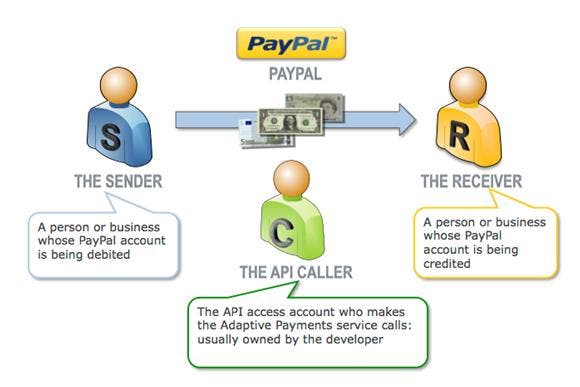
The Adaptive Payments API uses the Pay operation to make payments between a sender and one or more receivers of that payment. Payments can be split between receivers (in either "chained" or "parallel" modes) and additional operations in the API lets senders authorize and pre-approve an application to make payments on their behalf. The flexibility of the operations in the API make for an "adaptive" set of functions that addresses a wide range of payment scenarios.
As with any payment, payments made through the Adaptive Payments API must be authorized and approved by the payment sender. To provide the best possible user experience for senders, the Adaptive Payments API provides the following payment approval methods:
<dl>
<dt>Web Redirect</dt>
<dd>The default method where applications redirect the sender of the payment to PayPal for approval.</dd>
<dt>Embedded Process</dt>
<dd>Applications embed the payment authorization process into the application itself.</dd>
<dt>Implicit</dt>
<dd>Applications act as the sender of the payment and _implicitly_ authorize the payment.</dd>
<dt>Preapproved</dt>
<dd>Applications obtain a pre-approval from the sender.</dd>
</dl>To call the Adaptive Payments Pay operation, supply the necessary HTTP headers and the call payload to the service endpoint.
A call to the Pay operation involves these users:
To make the Pay call and authorize the payment after the Pay operation succeeds:
Obtain the endpoint for the service and environment you are addressing.The sandbox endpoint for the Adaptive Payments Pay operation is https://svcs.sandbox.paypal.com/AdaptivePayments/Pay.
Format the HTTP headers for the call. Supply the following headers to call the Pay operation:
// Sandbox API credentials for the API caller account
X-PAYPAL-SECURITY-USERID: <var>Sandbox-Caller-User-Id</var>
X-PAYPAL-SECURITY-PASSWORD: <var>Sandbox-Caller-Password</var>
X-PAYPAL-SECURITY-SIGNATURE: <var>Sandbox-Caller-Security-Signature</var>
// Global sandbox Application ID
X-PAYPAL-APPLICATION-ID: APP-80W284485P519543T
// Input and output formats
X-PAYPAL-REQUEST-DATA-FORMAT: JSON
X-PAYPAL-RESPONSE-DATA-FORMAT: JSON
Format the call payload. The Pay operation requires several payload input fields, shown here as a JSON object:
{
    [{
      "actionType": "PAY", // Payment action type
      "currencyCode": "USD", // Payment currency code
      "receiverList": {
        "receiver": [{
          "amount": "1.00", // Payment amount
          "email": "<var>Sandbox-Receiver-eMail</var>" // Receiver's email address
    }],
    "returnUrl": "https://example.com/return", // Redirect URL after approval
    "cancelUrl": "https://example.com/cancel", // Redirect URL after cancellation
    "requestEnvelope": {
      "errorLanguage": "en_US", // Language used to display errors
      "detailLevel": "ReturnAll" // Error detail level
  }
That's it. You're now set to make the call.
Make the call.
If the Pay call is successful — the ack field in the response contains Success— redirect the sender to PayPal so that he or she can authorize the payment:
1. Get the payKey value from the response of the Pay call. This example shows a successful Pay response:
{
  "responseEnvelope": {
    "timestamp": "2011-08-20T15:12:20.833-07:00", // Time stamp
    "ack": "Success", // Status
    "correlationId": "<var>nnnnnnnnnnnn</var>", // Correlation ID
    "build": "<var>nnnnnnn</var>" // Server version
  },
  "payKey": "<var>Your-payKey</var>", // Key used to authorize payment
  "paymentExecStatus": "CREATED" // Status of payment
  }
2. Use the payKey value in an authorization redirect to PayPal with this sandbox URI: https://www.sandbox.paypal.com/cgi-bin/webscr?cmd=_ap-payment&paykey=<Your-payKey> When redirected to PayPal, the sender is presented with a PayPal authorization window where they can log in and approve the payment.
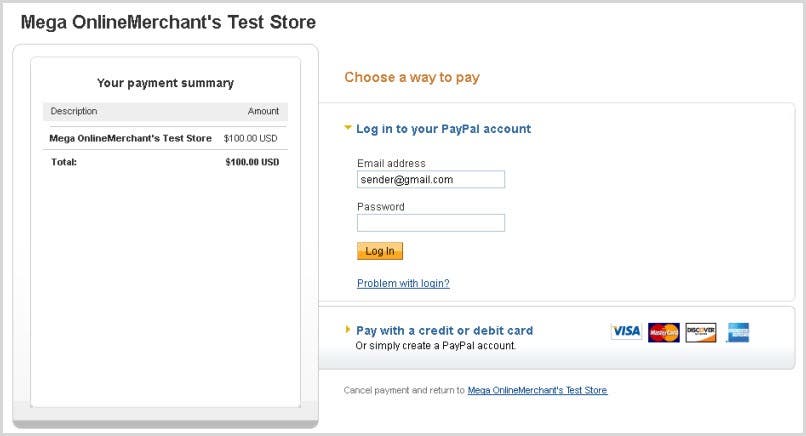
3. After the buyer authorizes the payment, the transaction is complete and he or she is redirected to the URL specified by the returnUrl input field in your Pay request.
Note: For a pre-approval, the authorization redirect is: <code>https://www.sandbox.paypal.com/cgi-bin/webscr?cmd=_ap-preapproval&preapprovalkey=Your-preapproval-key`
The following cURL command contains a call to the Pay operation. Run the command by copying and pasting it into a code window. (If cURL is not installed on your system, you can download the free cURL executable from https://curl.haxx.se/download.html.)
curl https://svcs.sandbox.paypal.com/AdaptivePayments/Pay \
  -s \
  --insecure \
  -H "X-PAYPAL-SECURITY-USERID: caller_1312486258_biz_api1.gmail.com" \
  -H "X-PAYPAL-SECURITY-PASSWORD: 1312486294" \
  -H "X-PAYPAL-SECURITY-SIGNATURE: AbtI7HV1xB428VygBUcIhARzxch4AL65.T18CTeylixNNxDZUu0iO87e" \
  -H "X-PAYPAL-REQUEST-DATA-FORMAT: JSON" \
  -H "X-PAYPAL-RESPONSE-DATA-FORMAT: JSON" \
  -H "X-PAYPAL-APPLICATION-ID: APP-80W284485P519543T" \
  -d '{
  "actionType": "PAY",
  "currencyCode": "USD",
  "receiverList": {
    "receiver": [{
      "amount": "1.00",
      "email": "rec1_1312486368_biz@gmail.com"
    }]
  },
  "returnUrl": "https://example.com/success.html",
  "cancelUrl": "https://example.com/failure.html",
  "requestEnvelope": {
    "errorLanguage": "en_US",
    "detailLevel": "ReturnAll"
  }
}'
You have made your first call to the Adaptive Payments API.
After you issue the command, the Adaptive Payments service returns a successful response that includes a valid sandbox payKey.
The previous call is made possible by the use of a publicly-available set of sandbox credentials (highlighted in the call). While you can extract the payKey from the response and use it in an authorization redirect, you cannot authorize the sandbox transaction. However, if you substitute the credentials and e-mail address from your sandbox accounts into the previous command, you can complete the entire transaction flow in the sandbox.
If your Pay call fails with your own sandbox credentials, review the call response for the error details and address the problem before you resubmit the call. If your call succeeds, insert the returned payKey value into this URL:
https://www.sandbox.paypal.com/cgi-bin/webscr?cmd=_ap-payment&paykey=<Your-payKey>Log in to the PayPal window with your sandbox buyer account credentials to complete the transaction. Then, log in to your sandbox account and review the account balances and e-mail to see the transaction results.
Use these suggestions to enhance your understanding of the Adaptive Payments API: