WebMCP is here: PayPal is helping every merchant become agent-ready

Sept 16, 2026
7 min read
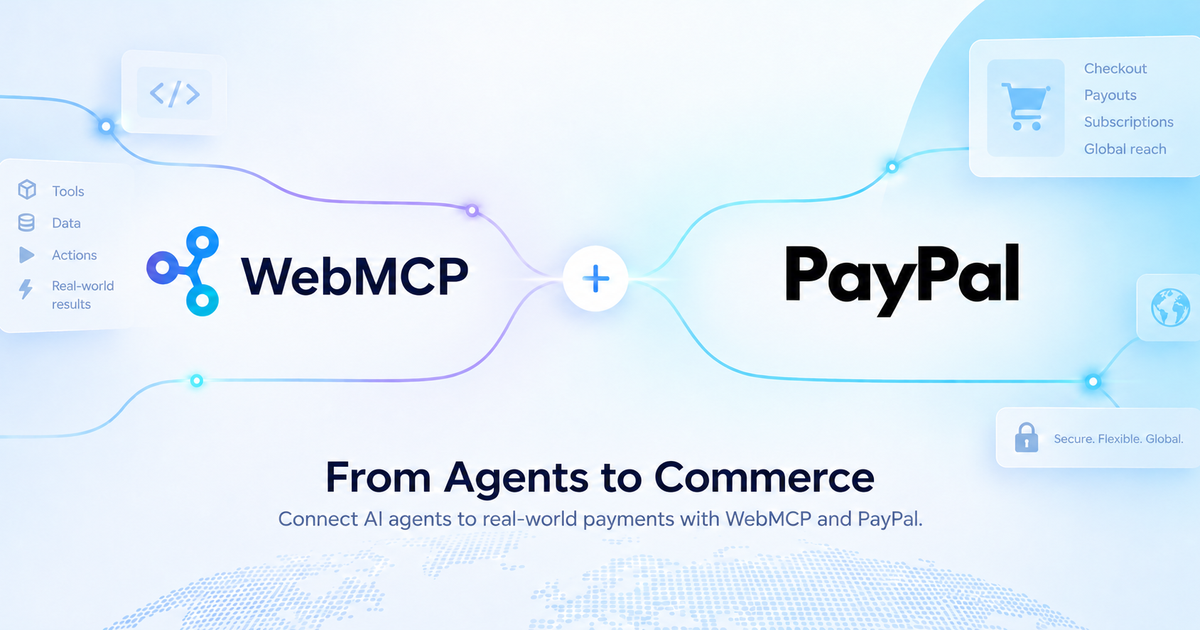
Make your PayPal-powered storefront easier for AI assisants to discover, navigate, and hand off to trusted checkout.
The next way customers shop is emerging now. People are increasingly asking AI assistants to find products, compare options, and help complete purchases. PayPal is working with the companies building this new experience, so merchants can participate in agent-driven commerce using their existing website storefronts.
Companies that maintain the top web browsers used by consumers, such as Google, Microsoft, and OpenAI are enabling support for the underlying WebMCP standard across their offerings like Chrome, Edge and ChatGPT Desktop App browser. This new standard provides a common framework for shopping agents and AI assistants to interact with online merchant storefronts when navigating the web in search of products. Recently, OpenAI released support for WebMCP in the ChatGPT desktop app built-in browser. For merchants, this trend represents an opportunity to make their online storefronts understandable to AI assistants and convert agentic traffic from consumers that start on these browsers. To enable the “last mile” of this shopping experience, PayPal is building support into our merchant acceptance network to streamline the checkout process for agents, while keeping payment approval, authentication, and buyer protection inside PayPal's trusted experience. Our goal is to make this functionality available for PayPal merchants that want to enable agentic checkout through their site.
What WebMCP means for your business
WebMCP is a proposed open web standard that lets compatible AI assistants interact with a website through clearly defined capabilities instead of trying to interpret every page visually. In a commerce journey, that can include allowing third-party agents to:
- Discovering products and product details
- Checking availability and options
- Building and updating a shopping cart
- Starting and completing checkout
Shopping agents enabled through WebMCP can help a shopper move closer to a purchase, but they also require a deterministic path to checkout. It does not replace the shopper or take control of payment credentials. The buyer remains in charge of approving the transaction. In PayPal's implementation for Store Sync merchants, it enables the agent to search, select, prepare the shopping cart, and initiate checkout. The buyer is then handed off to PayPal to sign in, choose or confirm a funding source, review the transaction, and approve payment.
Our Approach to Enabling WebMCP for your Business
PayPal already operates the payment moment where identity, funding choice, and payment authorization come together. By investing in building on top of the WebMCP standard, PayPal is helping connect an emerging AI shopping experience to the existing trusted infrastructure PayPal already offers.
To accomplish this, we are extending WebMCP support through the PayPal JavaScript SDK. For PayPal's merchants using our Store Sync platform, this new integration can make product discovery, cart actions, and checkout initiation available for compatible AI assistants. By enabling this capability, Store Sync merchants can:
- Reach customers through emerging AI shopping experiences, including ChatGPT and compatible browsers.
- Make product discovery and cart experiences easier for AI assistants to understand and use.
- Connect agent-assisted shopping journeys to their existing PayPal checkout and payment protections.
- Quickly participate in agentic commerce as the ecosystem develops, and customer demand evolves, with little to no development required.
This capability will be optional, giving PayPal Store Sync merchants a path to test, learn, and decide whether supporting agent-assisted shopping is helpful for their business. While this capability is limited to Store Sync customers today, PayPal will continue to test WebMCP based checkout across our merchant acceptance network and provide additional details on availability as more browsers support the standard.
The Customer Experience
Our approach combines the convenience of AI-assisted shopping with the safeguards buyers and merchants expect from PayPal. The agent helps with the automate key steps of the shopping journey for the consumer, while PayPal securely enables the checkout.
See the Experience in Action
PayPal's WebMCP reference experience: Click here to watch the video
Note: WebMCP and related browser capabilities are evolving. Availability, supported browsers, merchant enablement, and customer experiences may change as the ecosystem develops.
Early Results From Our Testing
In a benchmark using PayPal's new WebMCP capability in our test merchant storefront, an AI assistant was able to complete the same gift-card purchase using our structured WebMCP tools more efficiently over the existing web interface. When the new feature was enabled, we observed:
- Reduced Agent Compute Resources: Approximately 4.6 times less costly in model-inference usage when completing checkout.
- Faster E2E Checkout Completion: Approximately twice as fast at the median with WebMCP enabled.
- A More Consistent Experience: Using three structured tool calls via WebMCP instead of more than 30 interface-interaction steps with the feature disabled.
In summary, our internal benchmarks simulating a WebMCP enabled merchant storefront demonstrated a consistently faster and more efficient agentic checkout experience for the consumer. While these results are directional and based on a small sandbox benchmark - actual results will vary by storefront, catalog, and AI assistant - we think they highlight an opportunity for WebMCP enabled merchants to streamline agentic checkout on their existing online storefronts.
How to get started
If you are a PayPal merchant, now is a good time to understand how your storefront appears to AI assistants and prepare your catalog and site experience for this shift.
- Review your product information, availability, pricing, and checkout flows for clarity and consistency.
- Continue following web accessibility best practices so your storefront is navigable for all customers and technologies.
- Watch for PayPal guidance on expanded WebMCP support through the PayPal JavaScript SDK.
- Talk with your PayPal Account Manager if you want to discuss early enablement, testing, and participation.
The future of commerce will include more ways for customers to find and evaluate products. PayPal is helping merchants get ready for that future, while keeping buyers in control and helping payments stay trusted.
Recommended
Managing Recurring Payments with Apple Pay Using PayPal
4 min read

Why You Should Attend PayPal’s Developer Meetup at Money20/20
4 min read
Building a Customizable Messaging Platform
10 min read