On this page
No Headings
Last updated: June 4, 2026
Your account structure is contingent upon the settlement model you select. There are two settlement models:
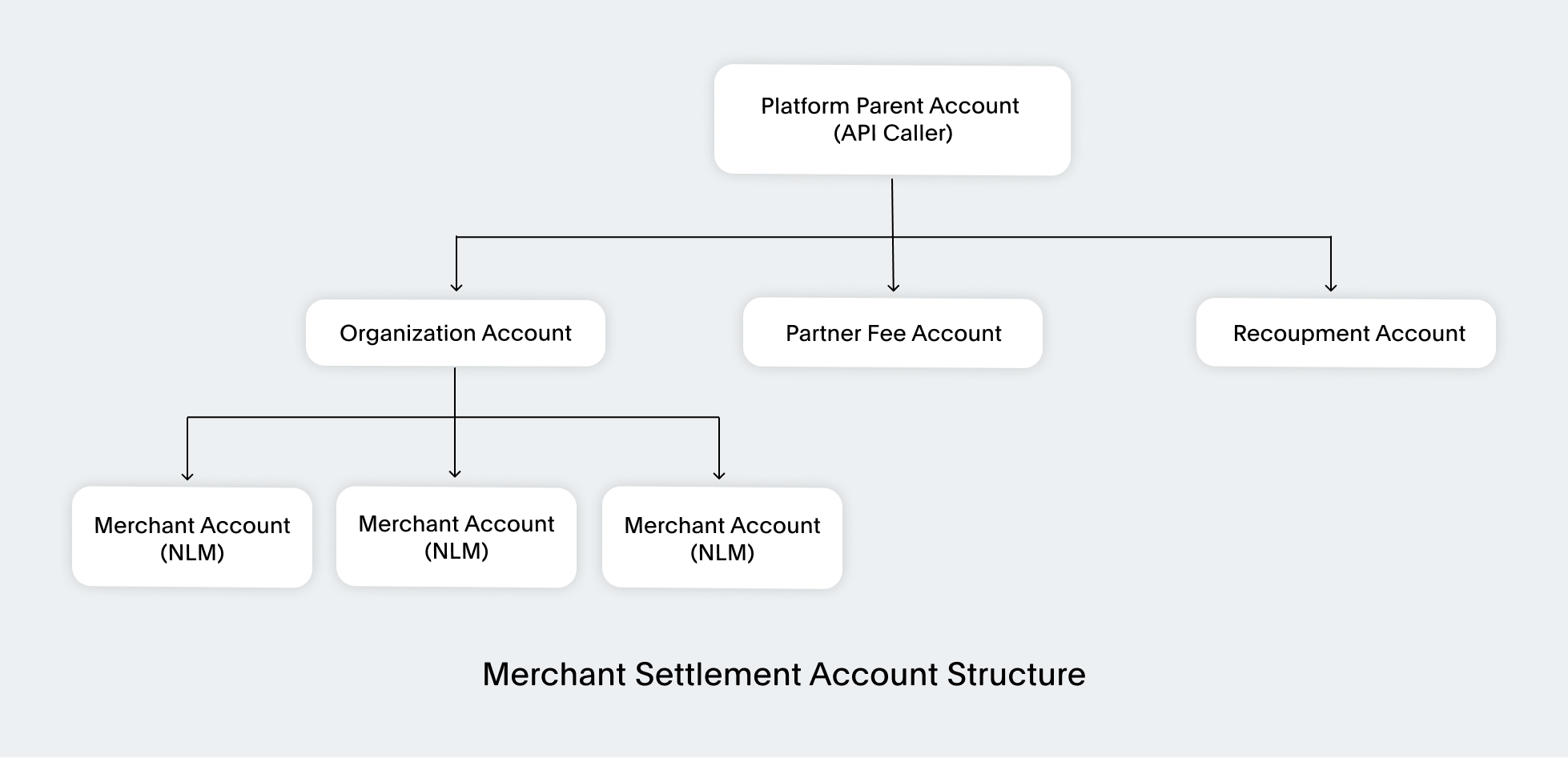
Merchant Settlement account: PayPal pays your merchants directly.
Partner Settlement account: PayPal issues payments to you, and you pay your merchants.

Be sure to create all accounts as PayPal business accounts. You'll create the same accounts in both sandbox and live environments.
You need certain accounts, such as API caller and Organization accounts, for both settlement models. Other accounts, such as partner fees and settlement accounts, are necessary only for a specific model.
The following table provides an overview of the different account types in Managed Path:
| Account | Purpose |
|---|---|
| API caller account | Use this account to run the PayPal APIs. Create a developer REST API app for this account and use the app to interact with the PayPal APIs. This account also has access to PayPal's SFTP server for reports. |
| Organization account | Acts as the parent for all non-loginable merchant accounts. All non-loginable merchant accounts that you create under this account inherit its settings. |
| Partner fee account | Use this account to settle partner or platform fees for transactions processed by non-loginable merchant accounts. This account requires a verified bank account attached to it for auto-sweep of fees. |
| Recoupment account | Use this account to recover costs from negative balances accumulated by merchants. This account does not require a bank account and pays fees through invoices. |
| Non-loginable merchant (NLM) account | This is the reference account you create for each merchant using the Managed Accounts API. A reference account is a non-loginable PayPal business account you manage fully through PayPal APIs. |
After creating the accounts, use your sandbox accounts to test onboarding and transactions before going live. You'll need to create and configure accounts to support the testing process.
Log in to your developer dashboard.
Select Testing Tools > Sandbox Accounts > Create accountfrom your developer dashboard.
For the customized account, select Create.
1. In Create Custom Sandbox Account, set Account type to Business.
2. Select the appropriate country in Country/Region.
3. In Account details, enter the account information.
4. In Payment methods, enter the PayPal balance as zero.
5. Select Create account.
Repeat Steps 2-3 for all the required PayPal accounts specific to your integration.
Note: After you create your sandbox accounts and REST API app's Client ID, share them with your PayPal integration engineer (or Contact us), to configure the sandbox environment.
Webhooks are HTTP callbacks that receive notification messages for events. You can subscribe to webhooks through the developer portal or by making an API call.
To subscribe to webhooks from your developer portal:
For more information about onboarding webhooks, payment webhooks, and other types of webhooks, see webhooks.
To subscribe to webhooks by making an API call, see Webhooks for the sample requests and responses. Refer to the event names for details on the webhook type you want to subscribe to.
For successful onboarding, subscribe to the following webhooks:
CUSTOMER.MANAGED-ACCOUNT.ACCOUNT-CREATED, which indicates that an account is created.CUSTOMER.MANAGED-ACCOUNT.ACCOUNT-STATUS-CHANGED, which indicates that the verification status of an account has changed.CUSTOMER.MANAGED-ACCOUNT.ACCOUNT-UPDATED, which is returned in response to a request to edit the account dataFor more information on these webhooks, see Create merchant accounts, Verify merchant accounts, and Update merchant accounts.
For configuring the applicable accounts in the Live environment, for your integration, work with your PayPal integration engineer (or Contact us) to ensure that the accounts are set up as expected.
The following credentials are essential to integrate and use PayPal REST APIs in your Managed Path integration:
The procedure to retrieve the Client ID is the same for sandbox and live environments. In the developer dashboard, ensure that you toggle to the appropriate environment to retrieve the correct credentials.
For related information, see PayPal Partner attribution ID.
After configuring your sandbox and live accounts, your PayPal integration engineer will provide the BN code.
The procedure to retrieve the partner-merchant ID is the same for sandbox and live environments. In the developer dashboard, ensure that you toggle to the appropriate environment to retrieve the correct credentials.